The self-publishing revolution is one of the greatest plot twists in publishing history.
Twenty years ago, telling someone you were self-publishing was often met with the literary equivalent of, “Oh… that’s nice, dear.” Today? Self-published authors are landing movie deals, topping bestseller lists, earning seven figures, and building empires from their living rooms while wearing pajama pants and arguing with Amazon ads at 2 a.m.
But here’s the million-dollar question: What are the actual odds of becoming a bestselling self-published author?
Spoiler alert: They’re simultaneously terrible and better than they’ve ever been.
From Rejection Letters to Royalty Checks: The Rise of the Self-Published Bestseller
Every year, millions of books are published worldwide. In 2025 alone, more than 4.2 million books were published in the United States, and approximately 3.5 million of those were self-published titles. Self-publishing isn’t the underdog anymore. It’s the publishing industry.
That sounds exciting until you realize you’re competing against approximately:
- 3.5 million self-published books
- Thousands of new releases every single day
- Readers with unlimited access to books for less than the price of their morning latte
Welcome to The Hunger Games: Indie Author Edition.
What Are Your Chances of Becoming a Bestseller?
Let’s talk numbers.
Most self-published books do not become bestsellers. In fact:
- Approximately 90% sell fewer than 100 copies over their lifetime.
- The average self-published book sells around 250 copies.
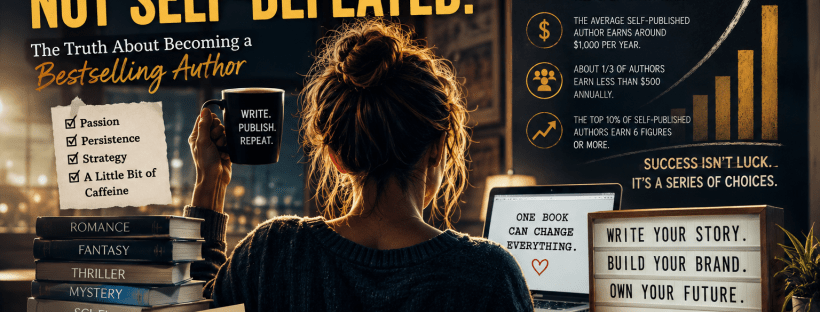
- The average self-published author earns roughly $1,000 annually from book sales.
- About one-third of self-published authors earn less than $500 annually from their books.
Before you ugly cry into your manuscript, remember something important.
The average includes people who:
- Published one book and disappeared.
- Never marketed their books.
- Uploaded a PDF and hoped readers would magically find it.
- Told absolutely no one they wrote a book.
Publishing a book is like opening a bakery in the middle of Manhattan and refusing to put a sign outside. Readers are not literary bloodhounds. They cannot smell your manuscript from three zip codes away.
The authors who succeed in self-publishing generally treat it like a business.
What Genres Perform Best in Self-Publishing?
The data consistently points to a few genres dominating self-publishing sales:
- Romance
- Fantasy and Romantasy
- Mystery and Thriller
- Science Fiction
- Young Adult Fiction
- Paranormal Romance
- Cozy Mysteries
- Self-Help and Business Books
- Children’s Books
- Contemporary Fiction
Romance remains the undisputed queen of self-publishing. Readers consume romance at astonishing rates, and series perform exceptionally well in the indie market. Approximately 75% of self-published book sales come from books that are part of a series.
The rise of BookTok has also transformed fantasy and romantasy into publishing powerhouses, producing viral sensations and multi-million-dollar publishing deals seemingly overnight.
In other words:
Dragons sell.
Billionaires sell.
Enemies-to-lovers sells.
Dragons who are secretly billionaire enemies-to-lovers?
Congratulations. You’ve basically purchased beachfront property on BookTok.
How Many Books Should Self-Published Authors Write?
This answer tends to disappoint first-time authors.
One book is rarely enough.
Successful indie authors typically publish multiple books annually. Many six and seven-figure indie authors release:
- Two to four novels per year
- Several novellas or bonus content releases
- Entire series within a relatively short period
The industry’s highest earners often have extensive backlists ranging from 10 to 50+ titles.
The truth is simple:
Readers don’t just fall in love with books. They fall in love with authors.
Give them one amazing book, and they’ll ask for another.
Give them twelve amazing books, and they’ll start arguing on social media over which fictional man deserves their affection.
That’s when you’ve officially made it.
Do Self-Published Bestsellers Stay Independent?
The answer is: sometimes.
Some authors never leave self-publishing because they enjoy:
- Higher royalty percentages
- Creative control
- Ownership of intellectual property
- Faster publishing schedules
- Greater flexibility with marketing
Others eventually sign lucrative traditional publishing deals.
Many bestselling authors have become “hybrid authors,” enjoying the best of both worlds.
Examples include authors who:
- Self-publish some series
- Traditionally publish others
- Sell foreign rights
- Negotiate film and television options
- Retain digital rights when possible
The publishing world has become significantly less “either-or” and much more “why not both?”
Top Bestselling Self-Published Authors
These authors have proven that independent publishing can compete at the highest levels:
- Colleen Hoover
- Hugh Howey
- Amanda Hocking
- E. L. James
- Andy Weir
- Bella Andre
- Mark Dawson
- Michael J. Sullivan
- Joanna Penn
- Rachel Abbott
Many of these authors have gone on to secure traditional publishing contracts while retaining portions of their publishing businesses. Others have remained fiercely independent because, quite frankly, their businesses were already outperforming what many traditional contracts could offer.
Self-Published Authors I’d Love to Interview
If someone could kindly make this happen, I promise to bring snacks and intelligent questions.
- Hugh Howey
- Bella Andre
- Mark Dawson
- Joanna Penn
- Michael J. Sullivan
- Amanda Hocking
- Rachel Abbott
- E. L. James
- Andy Weir
- Colleen Hoover
My first question to every single one of them would be:
At what point did you realize you weren’t simply writing books anymore, but building an author business?
Followed immediately by:
Did you ever ugly cry over a one-star review?
Because we’re all friends here.
Things Nobody Tells New Self-Published Authors
You are not competing against other authors.
You’re competing against:
- Netflix
- TikTok
- Sleep
- Social media
- Reader budgets
- Video games
- The twenty-seven unread books already sitting on someone’s Kindle
Readers don’t owe us their time.
We earn it one page at a time.
Success in self-publishing isn’t just about writing the next bestseller. It’s about consistency, professionalism, branding, networking, marketing, and having the audacity to continue writing when your first release only sells twelve copies.
Every bestselling author was once an unknown author refreshing their sales dashboard every four minutes.
(If you’re currently doing that, please drink some water and go write Chapter Two.)
The Question Every Author Should Ask
Instead of asking:
How do I become a bestselling author?
Perhaps we should ask:
How do I become an author readers trust enough to buy my next ten books?
The bestseller lists are wonderful.
Building a loyal readership that follows you for decades? That’s literary magic.
Readers & Writers: I Want Your Thoughts!
I’d love to hear from both readers and authors in the comments.
- Would you rather read a traditionally published book or a self-published book if the quality is the same?
- What makes you take a chance on an indie author?
- If you’re a self-published author, how many books have you written before finding your readership?
- Which self-published author do you think deserves far more recognition?
- Do you believe becoming a bestseller is luck, strategy, talent, or some combination of all three?
- If you could ask one bestselling self-published author a single question, what would it be?
Finally, here’s my favorite publishing statistic of all:
The overwhelming majority of authors who quit will never become bestsellers.
The overwhelming majority of authors who eventually succeed are the ones who kept writing long after everyone else stopped.
Turns out, perseverance may be the most underrated genre of all.
Sources
- Publishers Weekly, 2025 U.S. Book Output Statistics.
- BestWriting.com Self-Publishing Statistics (2026).
- Mary Adkins, Publishing Industry Data Analysis (2024).
- Newprint Book Sales Statistics (2025).
- Industry sales statistics aggregated by writing and publishing analysts.
- Reporting on the rise of Romantasy and BookTok-driven publishing trends.

